Read this revision page as text
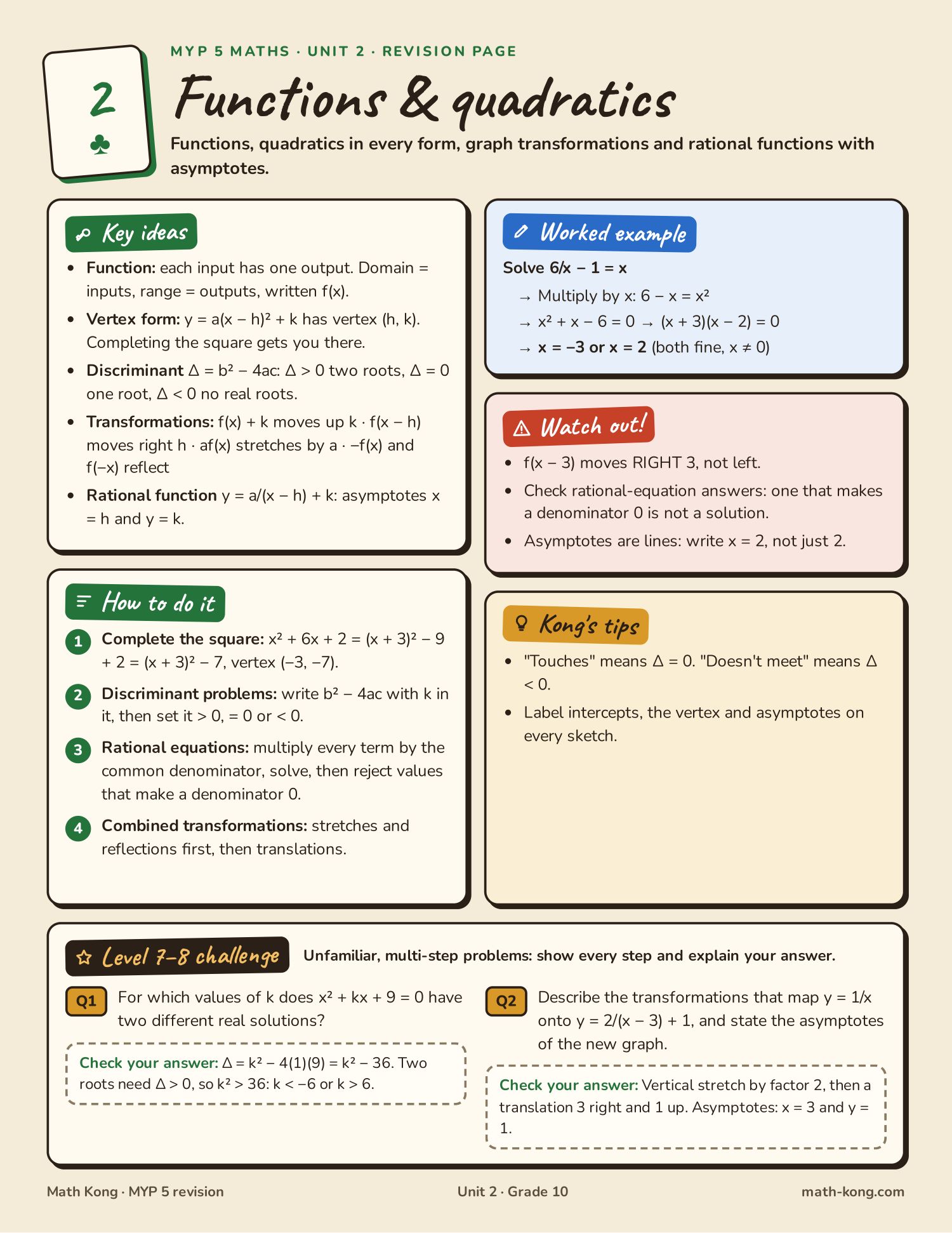
Functions, quadratics in every form, graph transformations and rational functions with asymptotes.
Key ideas
- Function: each input has one output. Domain = inputs, range = outputs, written f(x).
- Vertex form: y = a(x − h)² + k has vertex (h, k). Completing the square gets you there.
- Discriminant Δ = b² − 4ac: Δ > 0 two roots, Δ = 0 one root, Δ < 0 no real roots.
- Transformations: f(x) + k moves up k · f(x − h) moves right h · af(x) stretches by a · −f(x) and f(−x) reflect
- Rational function y = a/(x − h) + k: asymptotes x = h and y = k.
How to do it
- Complete the square: x² + 6x + 2 = (x + 3)² − 9 + 2 = (x + 3)² − 7, vertex (−3, −7).
- Discriminant problems: write b² − 4ac with k in it, then set it > 0, = 0 or < 0.
- Rational equations: multiply every term by the common denominator, solve, then reject values that make a denominator 0.
- Combined transformations: stretches and reflections first, then translations.
Worked example
- Solve 6/x − 1 = x
- → Multiply by x: 6 − x = x²
- → x² + x − 6 = 0 → (x + 3)(x − 2) = 0
- → x = −3 or x = 2 (both fine, x ≠ 0)
Watch out!
- f(x − 3) moves RIGHT 3, not left.
- Check rational-equation answers: one that makes a denominator 0 is not a solution.
- Asymptotes are lines: write x = 2, not just 2.
Kong's tips
- "Touches" means Δ = 0. "Doesn't meet" means Δ < 0.
- Label intercepts, the vertex and asymptotes on every sketch.
Level 7–8 challenge
- Unfamiliar, multi-step problems: show every step and explain your answer.
- Q1 For which values of k does x² + kx + 9 = 0 have two different real solutions?
- Check your answer: Δ = k² − 4(1)(9) = k² − 36. Two roots need Δ > 0, so k² > 36: k < −6 or k > 6.
- Q2 Describe the transformations that map y = 1/x onto y = 2/(x − 3) + 1, and state the asymptotes of the new graph.
- Check your answer: Vertical stretch by factor 2, then a translation 3 right and 1 up. Asymptotes: x = 3 and y = 1.
Quick notes
kong's tip"Touches" the x-axis means Δ = 0. "Doesn't meet" means Δ < 0. And on every sketch, label the intercepts, the vertex and any asymptotes — that's where the marks live.
Worked example
Solve 6/x − 1 = x
- Multiply by x: 6 − x = x²
- x² + x − 6 = 0 → (x + 3)(x − 2) = 0
- x = −3 or x = 2 (both fine, x ≠ 0)
watch outf(x − 3) moves the graph RIGHT 3, not left. Check rational-equation answers: one that makes a denominator 0 is not a solution. Asymptotes are lines: write x = 2, not just 2.
How to do it
Complete the square: x² + 6x + 2 = (x + 3)² − 9 + 2 = (x + 3)² − 7, so the vertex is (−3, −7).
Ready? Take the quiz below ↓
Five quick questions on this unit. No timer, no pressure — you can retry the whole set. Want it harder? Try the ⚡ challenge set after.