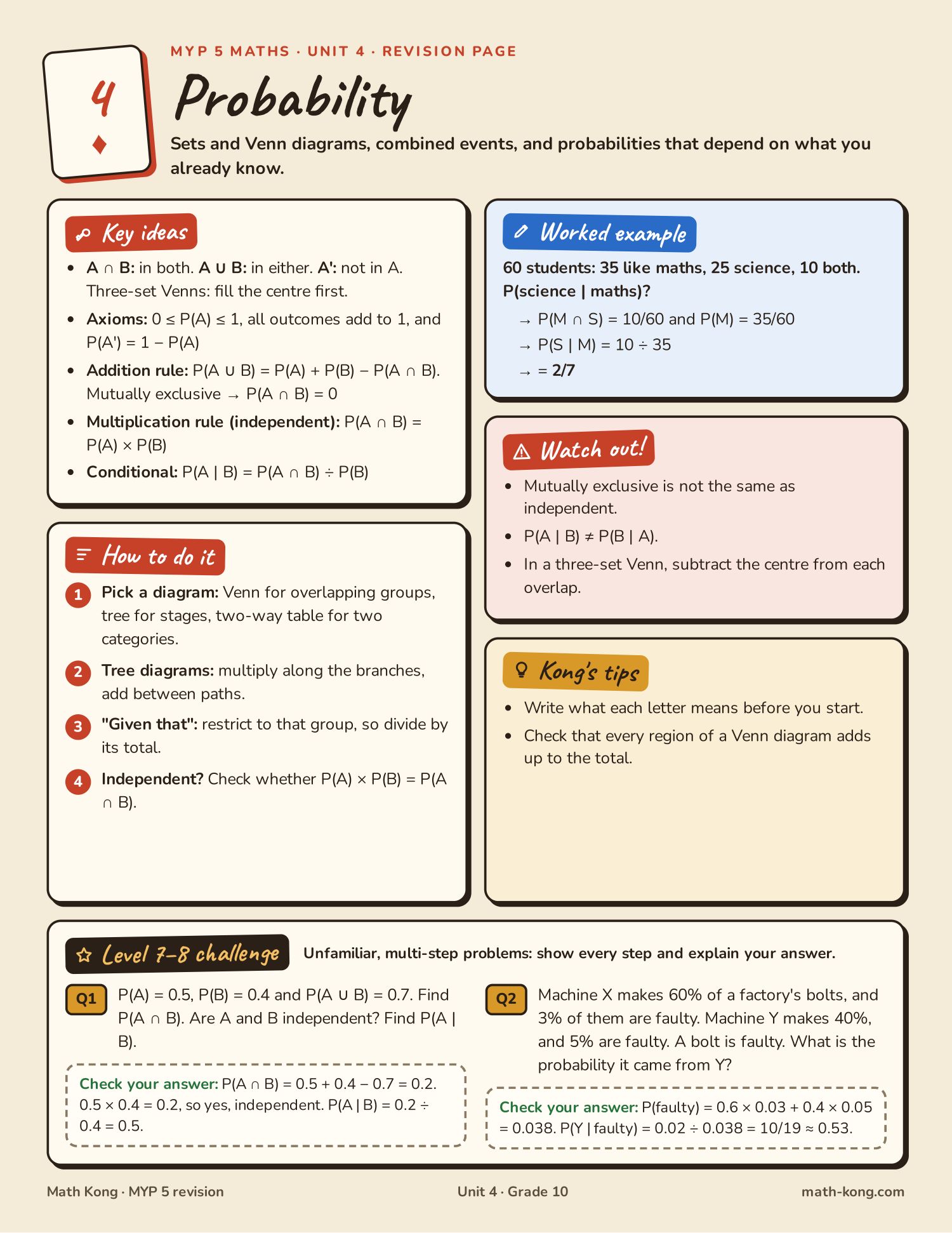
Read this revision page as text
Sets and Venn diagrams, combined events, and probabilities that depend on what you already know.
Key ideas
- A ∩ B: in both. A ∪ B: in either. A′: not in A. Three-set Venns: fill the centre first.
- Axioms: 0 ≤ P(A) ≤ 1, all outcomes add to 1, and P(A′) = 1 − P(A)
- Addition rule: P(A ∪ B) = P(A) + P(B) − P(A ∩ B). Mutually exclusive → P(A ∩ B) = 0
- Multiplication rule (independent): P(A ∩ B) = P(A) × P(B)
- Conditional: P(A | B) = P(A ∩ B) ÷ P(B)
How to do it
- Pick a diagram: Venn for overlapping groups, tree for stages, two-way table for two categories.
- Tree diagrams: multiply along the branches, add between paths.
- "Given that": restrict to that group, so divide by its total.
- Independent? Check whether P(A) × P(B) = P(A ∩ B).
Worked example
- 60 students: 35 like maths, 25 science, 10 both. P(science | maths)?
- → P(M ∩ S) = 10/60 and P(M) = 35/60
- → P(S | M) = 10 ÷ 35
- → = 2/7
Watch out!
- Mutually exclusive is not the same as independent.
- P(A | B) ≠ P(B | A).
- In a three-set Venn, subtract the centre from each overlap.
Kong's tips
- Write what each letter means before you start.
- Check that every region of a Venn diagram adds up to the total.
Level 7–8 challenge
- Unfamiliar, multi-step problems: show every step and explain your answer.
- Q1 P(A) = 0.5, P(B) = 0.4 and P(A ∪ B) = 0.7. Find P(A ∩ B). Are A and B independent? Find P(A | B).
- Check your answer: P(A ∩ B) = 0.5 + 0.4 − 0.7 = 0.2. 0.5 × 0.4 = 0.2, so yes, independent. P(A | B) = 0.2 ÷ 0.4 = 0.5.
- Q2 Machine X makes 60% of a factory's bolts, and 3% of them are faulty. Machine Y makes 40%, and 5% are faulty. A bolt is faulty. What is the probability it came from Y?
- Check your answer: P(faulty) = 0.6 × 0.03 + 0.4 × 0.05 = 0.038. P(Y | faulty) = 0.02 ÷ 0.038 = 10/19 ≈ 0.53.
Quick notes
kong's tipWrite what each letter means before you start. Then check that every region of your Venn diagram adds up to the total — it catches most mistakes.
Worked example
60 students: 35 like maths, 25 science, 10 both. P(science | maths)?
- P(M ∩ S) = 10/60 and P(M) = 35/60
- P(S | M) = 10 ÷ 35
- = 2/7
watch outMutually exclusive is NOT the same as independent. P(A | B) ≠ P(B | A). In a three-set Venn, subtract the centre from each overlap.
How to do it
"Given that" means restrict to that group, so divide by its total: P(A | B) = P(A ∩ B) ÷ P(B).
Ready? Take the quiz below ↓
Five quick questions on this unit. No timer, no pressure — you can retry the whole set. Want it harder? Try the ⚡ challenge set after.