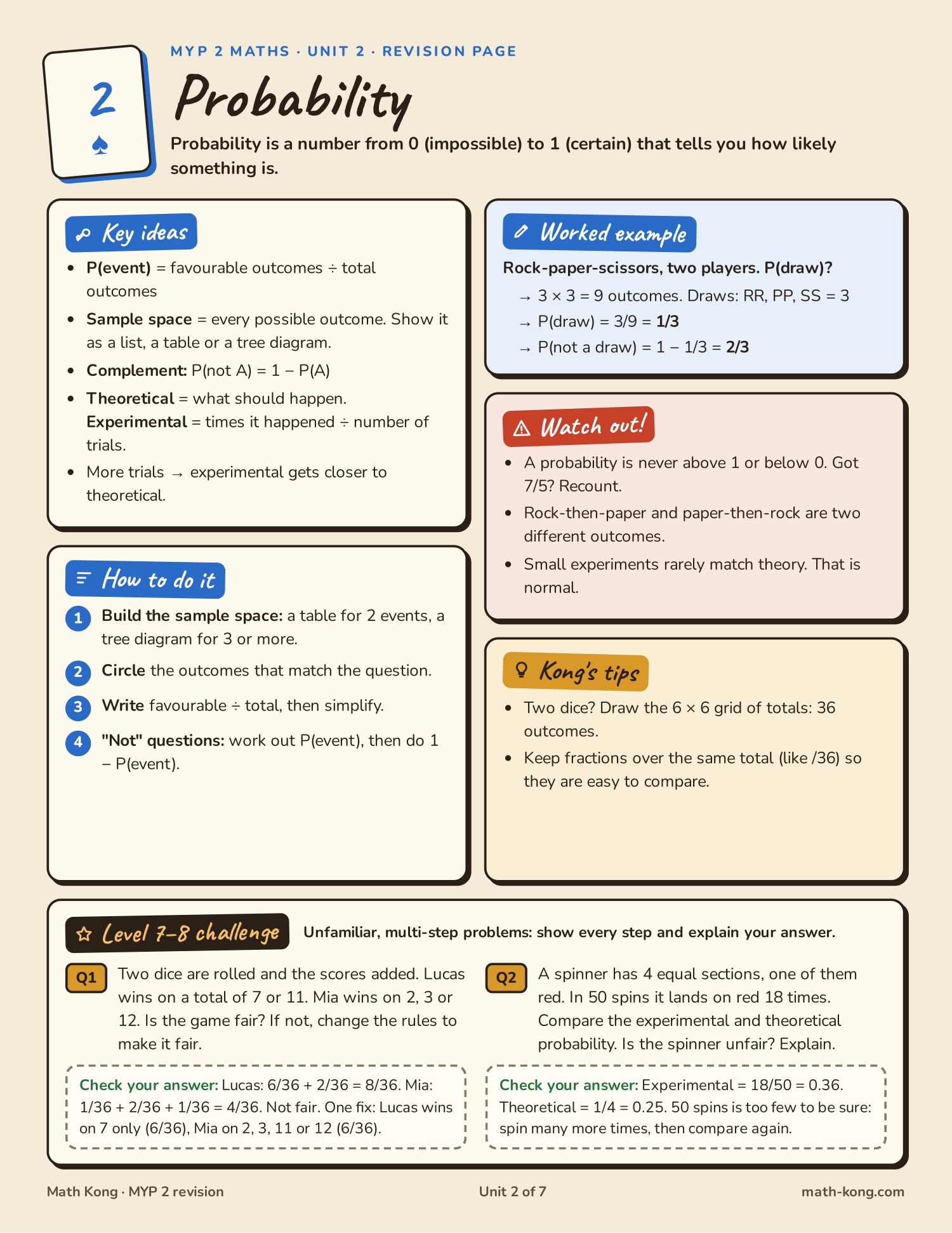
Read this revision page as text
Probability is a number from 0 (impossible) to 1 (certain) that tells you how likely something is.
Key ideas
- P(event) = favourable outcomes ÷ total outcomes
- Sample space = every possible outcome. Show it as a list, a table or a tree diagram.
- Complement: P(not A) = 1 − P(A)
- Theoretical = what should happen. Experimental = times it happened ÷ number of trials.
- More trials → experimental gets closer to theoretical.
How to do it
- Build the sample space: a table for 2 events, a tree diagram for 3 or more.
- Circle the outcomes that match the question.
- Write favourable ÷ total, then simplify.
- "Not" questions: work out P(event), then do 1 − P(event).
Worked example
- Rock-paper-scissors, two players. P(draw)?
- → 3 × 3 = 9 outcomes. Draws: RR, PP, SS = 3
- → P(draw) = 3/9 = 1/3
- → P(not a draw) = 1 − 1/3 = 2/3
Watch out!
- A probability is never above 1 or below 0. Got 7/5? Recount.
- Rock-then-paper and paper-then-rock are two different outcomes.
- Small experiments rarely match theory. That is normal.
Kong's tips
- Two dice? Draw the 6 × 6 grid of totals: 36 outcomes.
- Keep fractions over the same total (like /36) so they are easy to compare.
Level 7–8 challenge
- Unfamiliar, multi-step problems: show every step and explain your answer.
- Q1 Two dice are rolled and the scores added. Lucas wins on a total of 7 or 11. Mia wins on 2, 3 or 12. Is the game fair? If not, change the rules to make it fair.
- Check your answer: Lucas: 6/36 + 2/36 = 8/36. Mia: 1/36 + 2/36 + 1/36 = 4/36. Not fair. One fix: Lucas wins on 7 only (6/36), Mia on 2, 3, 11 or 12 (6/36).
- Q2 A spinner has 4 equal sections, one of them red. In 50 spins it lands on red 18 times. Compare the experimental and theoretical probability. Is the spinner unfair? Explain.
- Check your answer: Experimental = 18/50 = 0.36. Theoretical = 1/4 = 0.25. 50 spins is too few to be sure: spin many more times, then compare again.
Quick notes
kong's tipTwo dice? Draw the 6 × 6 grid of totals — 36 outcomes. Keep fractions over the same total (like /36) so they're easy to compare.
Worked example
Rock-paper-scissors, two players. P(draw)?
- 3 × 3 = 9 outcomes
- Draws: RR, PP, SS = 3
- P(draw) = 3/9 = 1/3
- P(not a draw) = 1 − 1/3 = 2/3
watch outA probability is never above 1 or below 0 — got 7/5? Recount. And rock-then-paper and paper-then-rock are two different outcomes.
How to do it
"Not" questions: work out P(event), then do 1 − P(event).
Ready? Take the quiz below ↓
Five quick questions on this unit. No timer, no pressure — you can retry the whole set. Want it harder? Try the ⚡ challenge set after.