Read this revision page as text
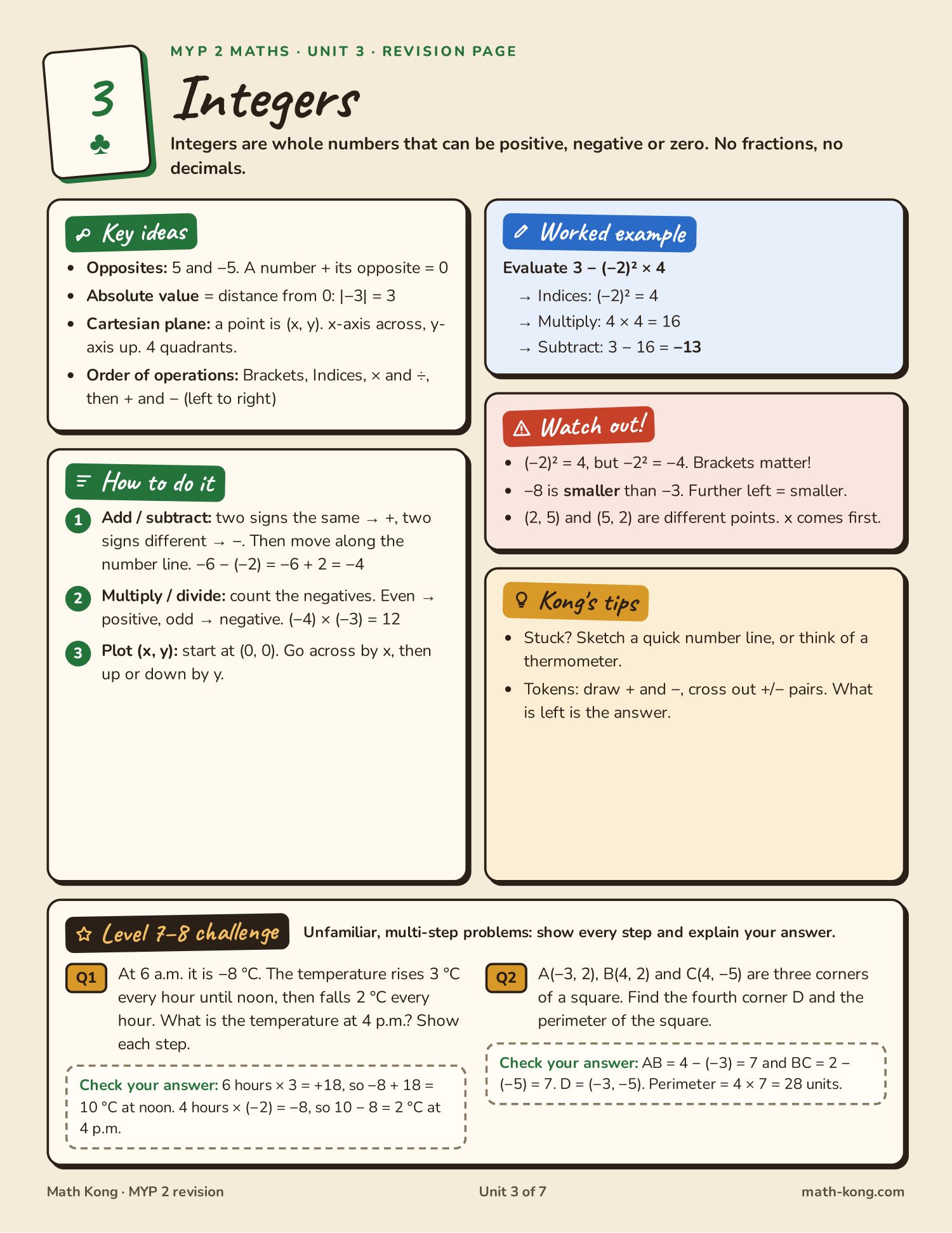
Integers are whole numbers that can be positive, negative or zero. No fractions, no decimals.
Key ideas
- Opposites: 5 and −5. A number + its opposite = 0
- Absolute value = distance from 0: |−3| = 3
- Cartesian plane: a point is (x, y). x-axis across, y- axis up. 4 quadrants.
- Order of operations: Brackets, Indices, × and ÷, then + and − (left to right)
How to do it
- Add / subtract: two signs the same → +, two signs different → −. Then move along the number line. −6 − (−2) = −6 + 2 = −4
- Multiply / divide: count the negatives. Even → positive, odd → negative. (−4) × (−3) = 12
- Plot (x, y): start at (0, 0). Go across by x, then up or down by y.
Worked example
- Evaluate 3 − (−2)² × 4
- → Indices: (−2)² = 4
- → Multiply: 4 × 4 = 16
- → Subtract: 3 − 16 = −13
Watch out!
- (−2)² = 4, but −2² = −4. Brackets matter!
- −8 is smaller than −3. Further left = smaller.
- (2, 5) and (5, 2) are different points. x comes first.
Kong's tips
- Stuck? Sketch a quick number line, or think of a thermometer.
- Tokens: draw + and −, cross out +/− pairs. What is left is the answer.
Level 7–8 challenge
- Unfamiliar, multi-step problems: show every step and explain your answer.
- Q1 At 6 a.m. it is −8 °C. The temperature rises 3 °C every hour until noon, then falls 2 °C every hour. What is the temperature at 4 p.m.? Show each step.
- Check your answer: 6 hours × 3 = +18, so −8 + 18 = 10 °C at noon. 4 hours × (−2) = −8, so 10 − 8 = 2 °C at 4 p.m.
- Q2 A(−3, 2), B(4, 2) and C(4, −5) are three corners of a square. Find the fourth corner D and the perimeter of the square.
- Check your answer: AB = 4 − (−3) = 7 and BC = 2 − (−5) = 7. D = (−3, −5). Perimeter = 4 × 7 = 28 units.
Quick notes
kong's tipStuck? Sketch a quick number line, or think of a thermometer. Further left = colder = smaller.
Worked example
Evaluate 3 − (−2)² × 4
- Indices: (−2)² = 4
- Multiply: 4 × 4 = 16
- Subtract: 3 − 16 = −13
watch out(−2)² = 4, but −2² = −4. Brackets matter! And (2, 5) and (5, 2) are different points — x comes first.
How to do it
Multiply or divide: count the negatives. Even → positive, odd → negative. (−4) × (−3) = 12.
Ready? Take the quiz below ↓
Five quick questions on this unit. No timer, no pressure — you can retry the whole set. Want it harder? Try the ⚡ challenge set after.