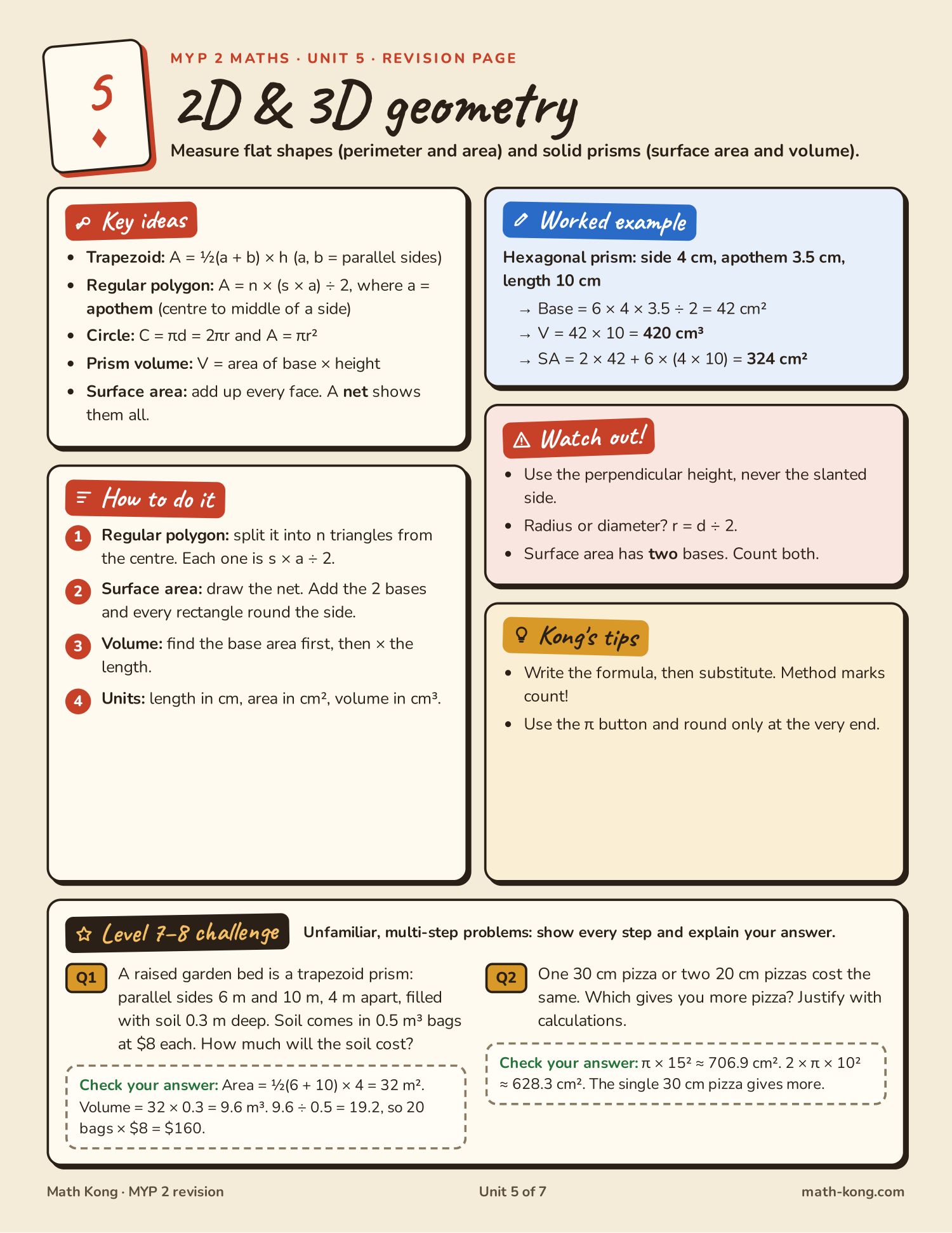
Read this revision page as text
Measure flat shapes (perimeter and area) and solid prisms (surface area and volume).
Key ideas
- Trapezoid: A = ½(a + b) × h (a, b = parallel sides)
- Regular polygon: A = n × (s × a) ÷ 2, where a = apothem (centre to middle of a side)
- Circle: C = πd = 2πr and A = πr²
- Prism volume: V = area of base × height
- Surface area: add up every face. A net shows them all.
How to do it
- Regular polygon: split it into n triangles from the centre. Each one is s × a ÷ 2.
- Surface area: draw the net. Add the 2 bases and every rectangle round the side.
- Volume: find the base area first, then × the length.
- Units: length in cm, area in cm², volume in cm³.
Worked example
- Hexagonal prism: side 4 cm, apothem 3.5 cm, length 10 cm
- → Base = 6 × 4 × 3.5 ÷ 2 = 42 cm² → V = 42 × 10 = 420 cm³
- → SA = 2 × 42 + 6 × (4 × 10) = 324 cm²
Watch out!
- Use the perpendicular height, never the slanted side.
- Radius or diameter? r = d ÷ 2.
- Surface area has two bases. Count both.
Kong's tips
- Write the formula, then substitute. Method marks count!
- Use the π button and round only at the very end.
Level 7–8 challenge
- Unfamiliar, multi-step problems: show every step and explain your answer.
- Q1 A raised garden bed is a trapezoid prism: parallel sides 6 m and 10 m, 4 m apart, filled with soil 0.3 m deep. Soil comes in 0.5 m³ bags at $8 each. How much will the soil cost?
- Check your answer: Area = ½(6 + 10) × 4 = 32 m². Volume = 32 × 0.3 = 9.6 m³. 9.6 ÷ 0.5 = 19.2, so 20 bags × $8 = $160.
- Q2 One 30 cm pizza or two 20 cm pizzas cost the same. Which gives you more pizza? Justify with calculations.
- Check your answer: π × 15² ≈ 706.9 cm². 2 × π × 10² ≈ 628.3 cm². The single 30 cm pizza gives more.
Quick notes
kong's tipWrite the formula, then substitute — method marks count! Use the π button and round only at the very end.
Worked example
Hexagonal prism: side 4 cm, apothem 3.5 cm, length 10 cm
- Base = 6 × 4 × 3.5 ÷ 2 = 42 cm²
- V = 42 × 10 = 420 cm³
- SA = 2 × 42 + 6 × (4 × 10) = 324 cm²
watch outUse the perpendicular height, never the slanted side. Radius or diameter? r = d ÷ 2. And surface area has two bases — count both.
How to do it
Volume of a prism: find the base area first, then × the length. Units: cm for length, cm² for area, cm³ for volume.
Ready? Take the quiz below ↓
Five quick questions on this unit. No timer, no pressure — you can retry the whole set. Want it harder? Try the ⚡ challenge set after.