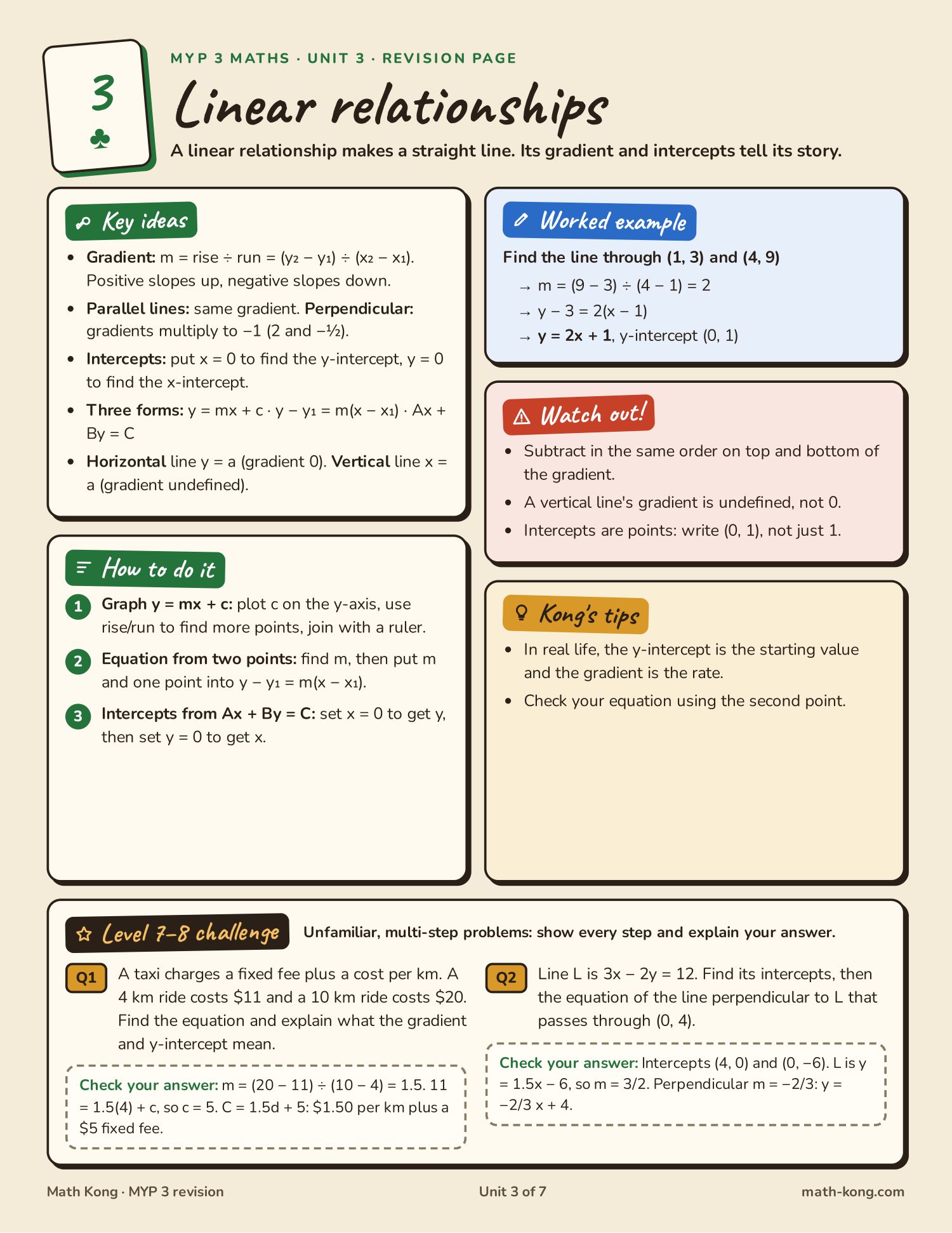
Read this revision page as text
A linear relationship makes a straight line. Its gradient and intercepts tell its story.
Key ideas
- Gradient: m = rise ÷ run = (y₂ − y₁) ÷ (x₂ − x₁). Positive slopes up, negative slopes down.
- Parallel lines: same gradient. Perpendicular: gradients multiply to −1 (2 and −½).
- Intercepts: put x = 0 to find the y-intercept, y = 0 to find the x-intercept.
- Three forms: y = mx + c · y − y₁ = m(x − x₁) · Ax + By = C
- Horizontal line y = a (gradient 0). Vertical line x = a (gradient undefined).
How to do it
- Graph y = mx + c: plot c on the y-axis, use rise/run to find more points, join with a ruler.
- Equation from two points: find m, then put m and one point into y − y₁ = m(x − x₁).
- Intercepts from Ax + By = C: set x = 0 to get y, then set y = 0 to get x.
Worked example
- Find the line through (1, 3) and (4, 9)
- → m = (9 − 3) ÷ (4 − 1) = 2
- → y − 3 = 2(x − 1) → y = 2x + 1, y-intercept (0, 1)
Watch out!
- Subtract in the same order on top and bottom of the gradient.
- A vertical line's gradient is undefined, not 0.
- Intercepts are points: write (0, 1), not just 1.
Kong's tips
- In real life, the y-intercept is the starting value and the gradient is the rate.
- Check your equation using the second point.
Level 7–8 challenge
- Unfamiliar, multi-step problems: show every step and explain your answer.
- Q1 A taxi charges a fixed fee plus a cost per km. A 4 km ride costs $11 and a 10 km ride costs $20. Find the equation and explain what the gradient and y-intercept mean.
- Check your answer: m = (20 − 11) ÷ (10 − 4) = 1.5. 11 = 1.5(4) + c, so c = 5. C = 1.5d + 5: $1.50 per km plus a $5 fixed fee.
- Q2 Line L is 3x − 2y = 12. Find its intercepts, then the equation of the line perpendicular to L that passes through (0, 4).
- Check your answer: Intercepts (4, 0) and (0, −6). L is y = 1.5x − 6, so m = 3/2. Perpendicular m = −2/3: y = −2/3 x + 4.
Quick notes
kong's tipIn real life, the y-intercept is the starting value and the gradient is the rate. Check your equation using the second point.
Worked example
Find the line through (1, 3) and (4, 9)
- m = (9 − 3) ÷ (4 − 1) = 2
- y − 3 = 2(x − 1)
- y = 2x + 1, y-intercept (0, 1)
watch outSubtract in the same order on the top and bottom of the gradient. A vertical line's gradient is undefined, not 0. Intercepts are points: write (0, 1), not just 1.
How to do it
Equation from two points: find m, then put m and one point into y − y₁ = m(x − x₁).
Ready? Take the quiz below ↓
Five quick questions on this unit. No timer, no pressure — you can retry the whole set. Want it harder? Try the ⚡ challenge set after.