Read this revision page as text
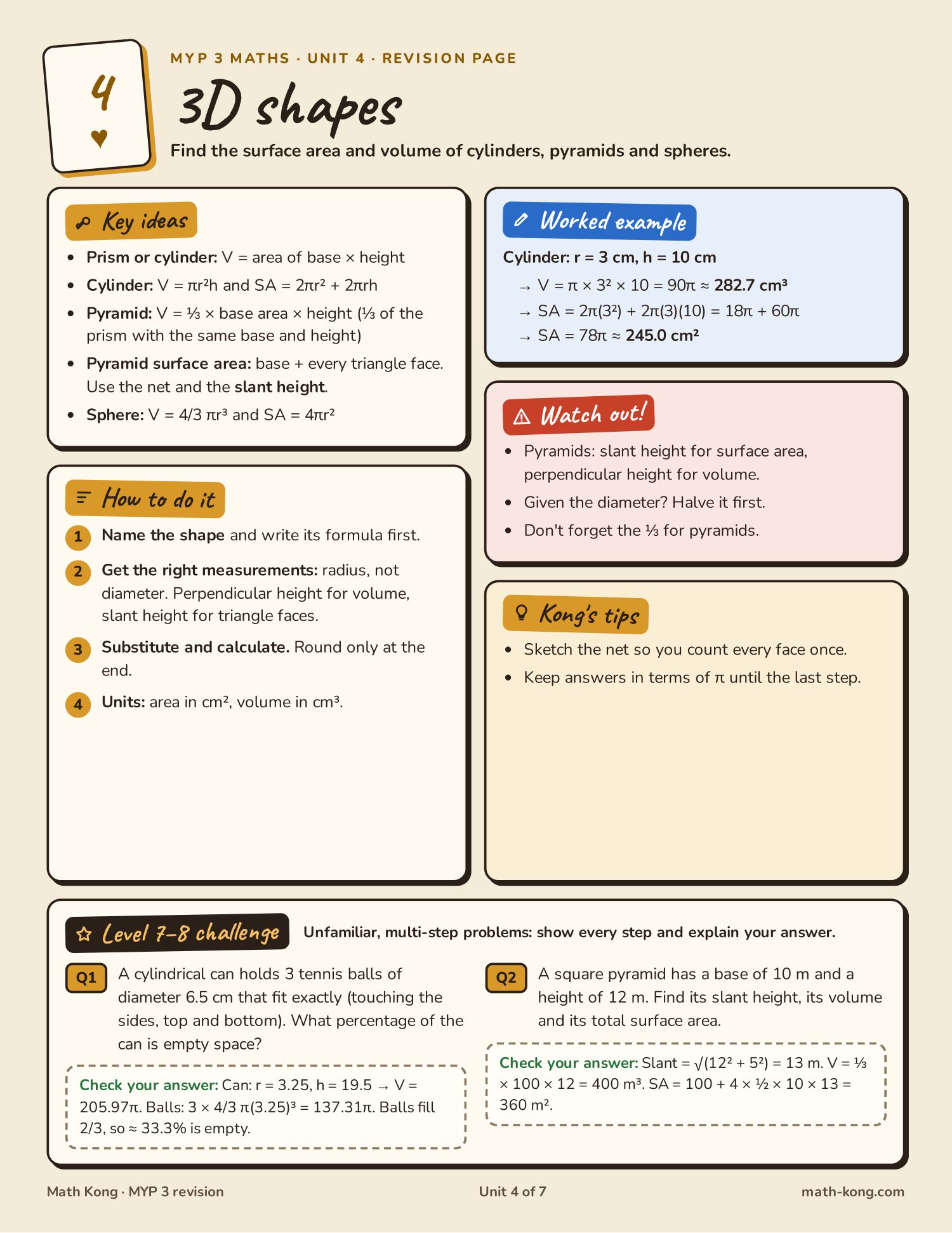
Find the surface area and volume of cylinders, pyramids and spheres.
Key ideas
- Prism or cylinder: V = area of base × height
- Cylinder: V = πr²h and SA = 2πr² + 2πrh
- Pyramid: V = ⅓ × base area × height (⅓ of the prism with the same base and height)
- Pyramid surface area: base + every triangle face. Use the net and the slant height.
- Sphere: V = 4/3 πr³ and SA = 4πr²
How to do it
- Name the shape and write its formula first.
- Get the right measurements: radius, not diameter. Perpendicular height for volume, slant height for triangle faces.
- Substitute and calculate. Round only at the end.
- Units: area in cm², volume in cm³.
Worked example
- Cylinder: r = 3 cm, h = 10 cm
- → V = π × 3² × 10 = 90π ≈ 282.7 cm³
- → SA = 2π(3²) + 2π(3)(10) = 18π + 60π → SA = 78π ≈ 245.0 cm²
Watch out!
- Pyramids: slant height for surface area, perpendicular height for volume.
- Given the diameter? Halve it first.
- Don't forget the ⅓ for pyramids.
Kong's tips
- Sketch the net so you count every face once.
- Keep answers in terms of π until the last step.
Level 7–8 challenge
- Unfamiliar, multi-step problems: show every step and explain your answer.
- Q1 A cylindrical can holds 3 tennis balls of diameter 6.5 cm that fit exactly (touching the sides, top and bottom). What percentage of the can is empty space?
- Check your answer: Can: r = 3.25, h = 19.5 → V = 205.97π. Balls: 3 × 4/3 π(3.25)³ = 137.31π. Balls fill 2/3, so ≈ 33.3% is empty.
- Q2 A square pyramid has a base of 10 m and a height of 12 m. Find its slant height, its volume and its total surface area.
- Check your answer: Slant = √(12² + 5²) = 13 m. V = ⅓ × 100 × 12 = 400 m³. SA = 100 + 4 × ½ × 10 × 13 = 360 m².
Quick notes
kong's tipSketch the net so you count every face once. Keep answers in terms of π until the very last step.
Worked example
Cylinder: r = 3 cm, h = 10 cm
- V = π × 3² × 10 = 90π ≈ 282.7 cm³
- SA = 2π(3²) + 2π(3)(10) = 18π + 60π
- SA = 78π ≈ 245.0 cm²
watch outPyramids: slant height for surface area, perpendicular height for volume. Given the diameter? Halve it first. Don't forget the ⅓ for pyramids.
How to do it
Name the shape and write its formula first, then substitute. Round only at the end — area in cm², volume in cm³.
Ready? Take the quiz below ↓
Five quick questions on this unit. No timer, no pressure — you can retry the whole set. Want it harder? Try the ⚡ challenge set after.