Read this revision page as text
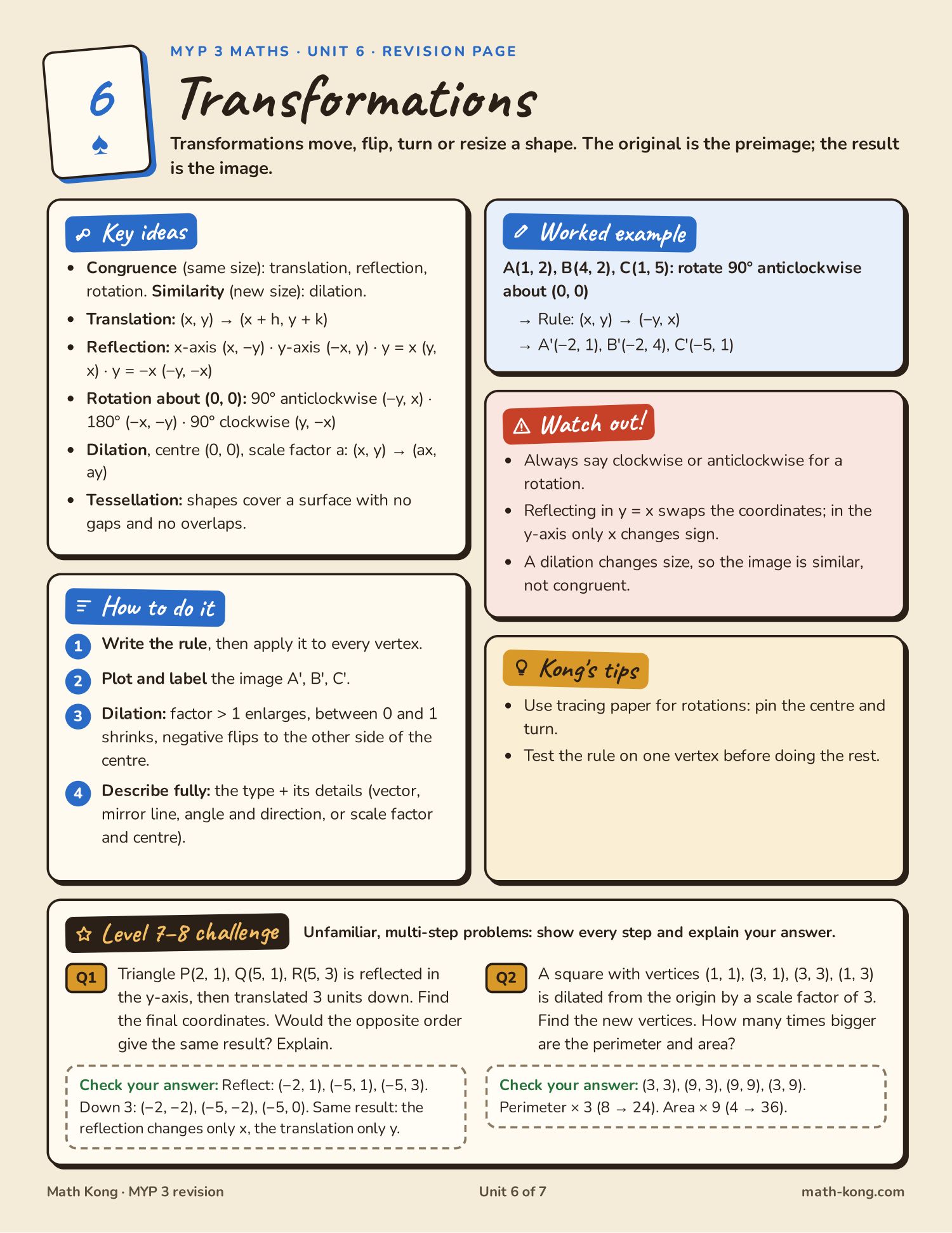
Transformations move, flip, turn or resize a shape. The original is the preimage; the result is the image.
Key ideas
- Congruence (same size): translation, reflection, rotation. Similarity (new size): dilation.
- Translation: (x, y) → (x + h, y + k)
- Reflection: x-axis (x, −y) · y-axis (−x, y) · y = x (y, x) · y = −x (−y, −x)
- Rotation about (0, 0): 90° anticlockwise (−y, x) · 180° (−x, −y) · 90° clockwise (y, −x)
- Dilation, centre (0, 0), scale factor a: (x, y) → (ax, ay)
- Tessellation: shapes cover a surface with no gaps and no overlaps.
How to do it
- Write the rule, then apply it to every vertex.
- Plot and label the image A′, B′, C′.
- Dilation: factor > 1 enlarges, between 0 and 1 shrinks, negative flips to the other side of the centre.
- Describe fully: the type + its details (vector, mirror line, angle and direction, or scale factor and centre).
Worked example
- A(1, 2), B(4, 2), C(1, 5): rotate 90° anticlockwise about (0, 0)
- → Rule: (x, y) → (−y, x)
- → A′(−2, 1), B′(−2, 4), C′(−5, 1)
Watch out!
- Always say clockwise or anticlockwise for a rotation.
- Reflecting in y = x swaps the coordinates; in the y-axis only x changes sign.
- A dilation changes size, so the image is similar, not congruent.
Kong's tips
- Use tracing paper for rotations: pin the centre and turn.
- Test the rule on one vertex before doing the rest.
Level 7–8 challenge
- Unfamiliar, multi-step problems: show every step and explain your answer.
- Q1 Triangle P(2, 1), Q(5, 1), R(5, 3) is reflected in the y-axis, then translated 3 units down. Find the final coordinates. Would the opposite order give the same result? Explain.
- Check your answer: Reflect: (−2, 1), (−5, 1), (−5, 3). Down 3: (−2, −2), (−5, −2), (−5, 0). Same result: the reflection changes only x, the translation only y.
- Q2 A square with vertices (1, 1), (3, 1), (3, 3), (1, 3) is dilated from the origin by a scale factor of 3. Find the new vertices. How many times bigger are the perimeter and area?
- Check your answer: (3, 3), (9, 3), (9, 9), (3, 9). Perimeter × 3 (8 → 24). Area × 9 (4 → 36).
Quick notes
kong's tipUse tracing paper for rotations: pin the centre and turn. Test your rule on one vertex before doing the rest.
Worked example
A(1, 2), B(4, 2), C(1, 5): rotate 90° anticlockwise about (0, 0)
- Rule: (x, y) → (−y, x)
- A′(−2, 1), B′(−2, 4)
- C′(−5, 1)
watch outAlways say clockwise or anticlockwise for a rotation. Reflecting in y = x swaps the coordinates; in the y-axis only x changes sign. A dilation changes size, so the image is similar, not congruent.
How to do it
Describe fully: the type + its details (vector, mirror line, angle and direction, or scale factor and centre).
Ready? Take the quiz below ↓
Five quick questions on this unit. No timer, no pressure — you can retry the whole set. Want it harder? Try the ⚡ challenge set after.