Read this revision page as text
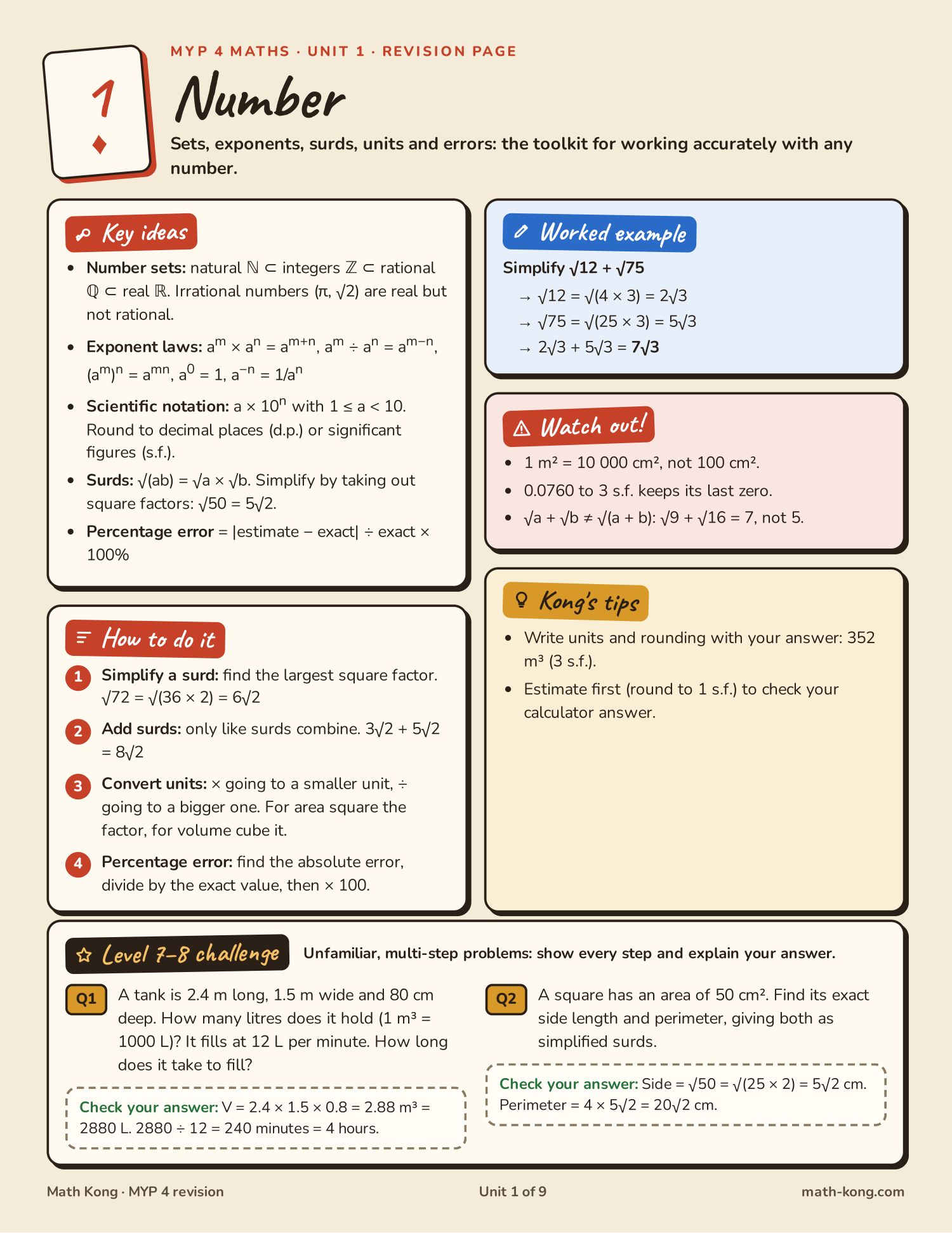
Sets, exponents, surds, units and errors: the toolkit for working accurately with any number.
Key ideas
- Number sets: natural ℕ ⊂ integers ℤ ⊂ rational ℚ ⊂ real ℝ. Irrational numbers (π, √2) are real but not rational.
- Exponent laws: am × aⁿ = am+n, am ÷ aⁿ = am−n, (am)ⁿ = amn, a⁰ = 1, a⁻ⁿ = 1/aⁿ
- Scientific notation: a × 10ⁿ with 1 ≤ a < 10. Round to decimal places (d.p.) or significant figures (s.f.).
- Surds: √(ab) = √a × √b. Simplify by taking out square factors: √50 = 5√2.
- Percentage error = |estimate − exact| ÷ exact × 100%
How to do it
- Simplify a surd: find the largest square factor. √72 = √(36 × 2) = 6√2
- Add surds: only like surds combine. 3√2 + 5√2 = 8√2
- Convert units: × going to a smaller unit, ÷ going to a bigger one. For area square the factor, for volume cube it.
- Percentage error: find the absolute error, divide by the exact value, then × 100.
Worked example
- Simplify √12 + √75
- → √12 = √(4 × 3) = 2√3
- → √75 = √(25 × 3) = 5√3
- → 2√3 + 5√3 = 7√3
Watch out!
- 1 m² = 10 000 cm², not 100 cm².
- 0.0760 to 3 s.f. keeps its last zero.
- √a + √b ≠ √(a + b): √9 + √16 = 7, not 5.
Kong's tips
- Write units and rounding with your answer: 352 m³ (3 s.f.).
- Estimate first (round to 1 s.f.) to check your calculator answer.
Level 7–8 challenge
- Unfamiliar, multi-step problems: show every step and explain your answer.
- Q1 A tank is 2.4 m long, 1.5 m wide and 80 cm deep. How many litres does it hold (1 m³ = 1000 L)? It fills at 12 L per minute. How long does it take to fill?
- Check your answer: V = 2.4 × 1.5 × 0.8 = 2.88 m³ = 2880 L. 2880 ÷ 12 = 240 minutes = 4 hours.
- Q2 A square has an area of 50 cm². Find its exact side length and perimeter, giving both as simplified surds.
- Check your answer: Side = √50 = √(25 × 2) = 5√2 cm. Perimeter = 4 × 5√2 = 20√2 cm.
Quick notes
kong's tipThink of a surd like a messy drawer: pull out the biggest square factor and tidy it. √72 = √(36 × 2) = 6√2. And always estimate first (round to 1 s.f.) so you can tell if your calculator answer makes sense.
Worked example
Simplify √12 + √75
- √12 = √(4 × 3) = 2√3
- √75 = √(25 × 3) = 5√3
- 2√3 + 5√3 = 7√3
watch out1 m² = 10 000 cm², not 100 cm² — square the conversion factor for area. And √a + √b ≠ √(a + b): √9 + √16 = 7, not 5.
How to do it
Only like surds combine: 3√2 + 5√2 = 8√2. Simplify each surd first, then look for matching ones.
Ready? Take the quiz below ↓
Five quick questions on this unit. No timer, no pressure — you can retry the whole set. Want it harder? Try the ⚡ challenge set after.