Read this revision page as text
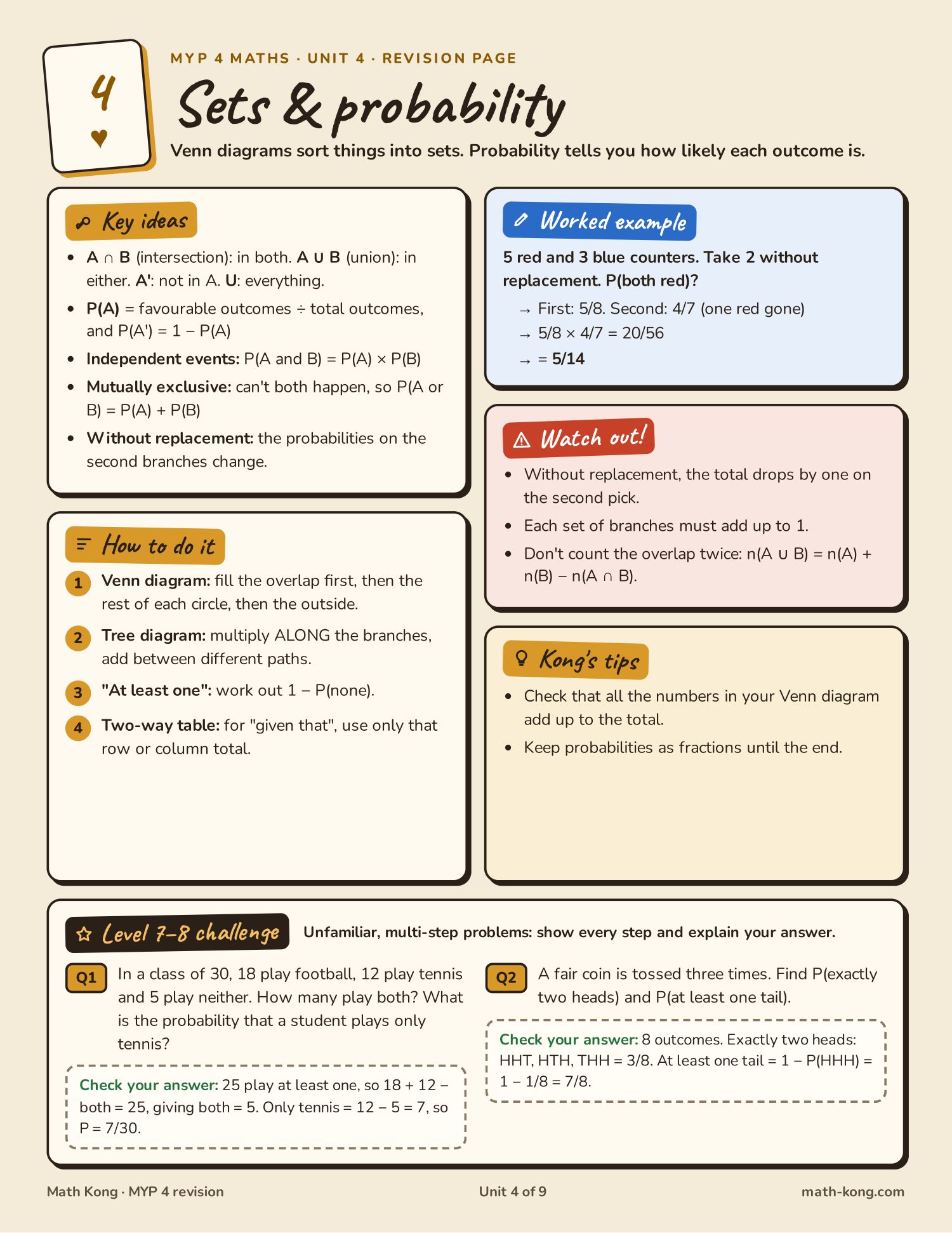
Venn diagrams sort things into sets. Probability tells you how likely each outcome is.
Key ideas
- A ∩ B (intersection): in both. A ∪ B (union): in either. A′: not in A. U: everything.
- P(A) = favourable outcomes ÷ total outcomes, and P(A′) = 1 − P(A)
- Independent events: P(A and B) = P(A) × P(B)
- Mutually exclusive: can't both happen, so P(A or B) = P(A) + P(B)
- Without replacement: the probabilities on the second branches change.
How to do it
- Venn diagram: fill the overlap first, then the rest of each circle, then the outside.
- Tree diagram: multiply ALONG the branches, add between different paths.
- "At least one": work out 1 − P(none).
- Two-way table: for "given that", use only that row or column total.
Worked example
- 5 red and 3 blue counters. Take 2 without replacement. P(both red)?
- → First: 5/8. Second: 4/7 (one red gone) → 5/8 × 4/7 = 20/56
- → = 5/14
Watch out!
- Without replacement, the total drops by one on the second pick.
- Each set of branches must add up to 1.
- Don't count the overlap twice: n(A ∪ B) = n(A) + n(B) − n(A ∩ B).
Kong's tips
- Check that all the numbers in your Venn diagram add up to the total.
- Keep probabilities as fractions until the end.
Level 7–8 challenge
- Unfamiliar, multi-step problems: show every step and explain your answer.
- Q1 In a class of 30, 18 play football, 12 play tennis and 5 play neither. How many play both? What is the probability that a student plays only tennis?
- Check your answer: 25 play at least one, so 18 + 12 − both = 25, giving both = 5. Only tennis = 12 − 5 = 7, so P = 7/30.
- Q2 A fair coin is tossed three times. Find P(exactly two heads) and P(at least one tail).
- Check your answer: 8 outcomes. Exactly two heads: HHT, HTH, THH = 3/8. At least one tail = 1 − P(HHH) = 1 − 1/8 = 7/8.
Quick notes
kong's tipFill a Venn diagram from the inside out: overlap first, then the rest of each circle, then the outside. At the end, check every number adds up to the total.
Worked example
5 red, 3 blue counters. Take 2 without replacement. P(both red)?
- First: 5/8. Second: 4/7 (one red gone)
- 5/8 × 4/7 = 20/56
- = 5/14
watch outWithout replacement, the total drops by one on the second pick. Each set of branches must add up to 1. Don't count the overlap twice: n(A ∪ B) = n(A) + n(B) − n(A ∩ B).
How to do it
'At least one' questions: work out 1 − P(none). Much faster than adding up every case.
Ready? Take the quiz below ↓
Five quick questions on this unit. No timer, no pressure — you can retry the whole set. Want it harder? Try the ⚡ challenge set after.