Read this revision page as text
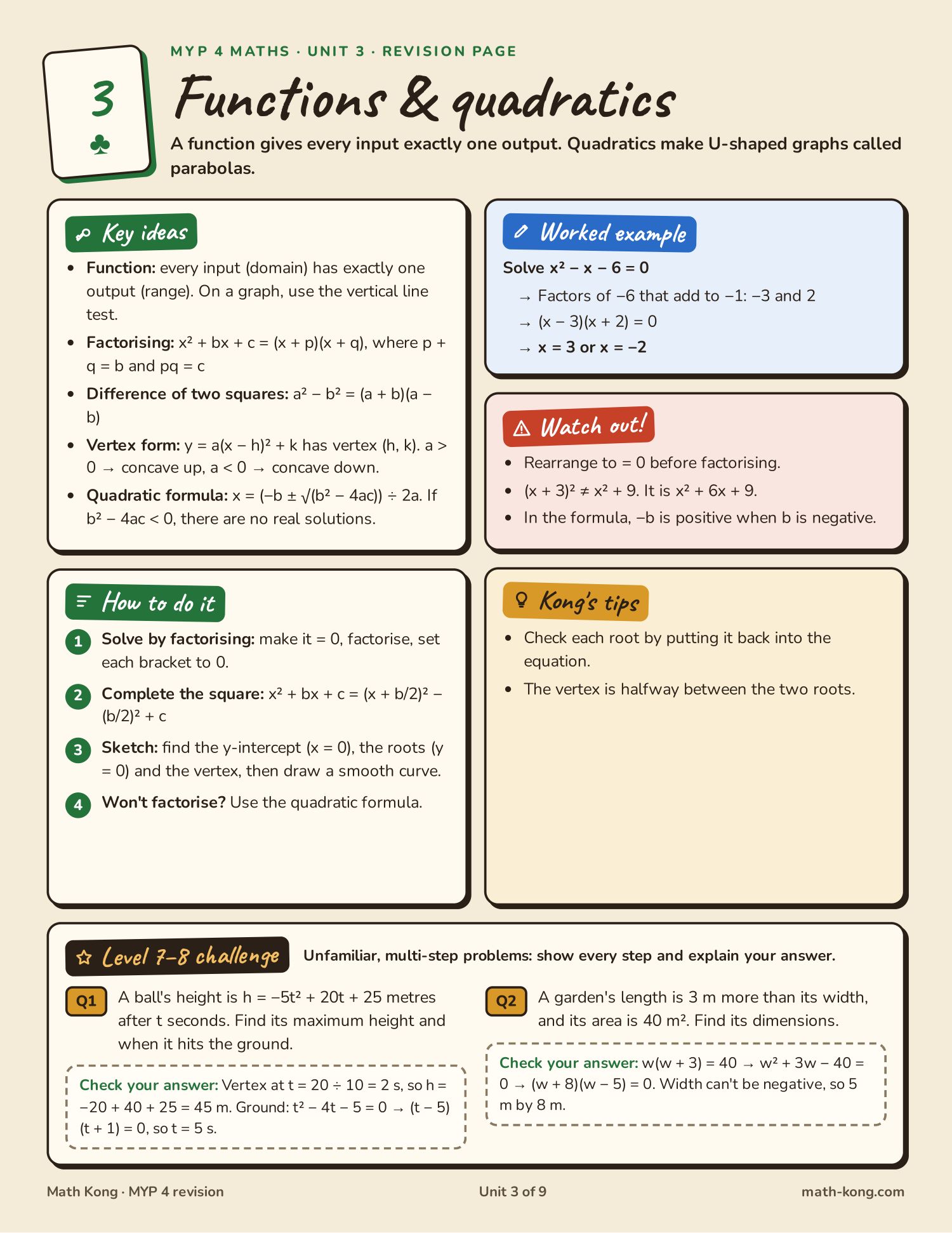
A function gives every input exactly one output. Quadratics make U-shaped graphs called parabolas.
Key ideas
- Function: every input (domain) has exactly one output (range). On a graph, use the vertical line test.
- Factorising: x² + bx + c = (x + p)(x + q), where p + q = b and pq = c
- Difference of two squares: a² − b² = (a + b)(a − b)
- Vertex form: y = a(x − h)² + k has vertex (h, k). a > 0 → concave up, a < 0 → concave down.
- Quadratic formula: x = (−b ± √(b² − 4ac)) ÷ 2a. If b² − 4ac < 0, there are no real solutions.
How to do it
- Solve by factorising: make it = 0, factorise, set each bracket to 0.
- Complete the square: x² + bx + c = (x + b/2)² − (b/2)² + c
- Sketch: find the y-intercept (x = 0), the roots (y = 0) and the vertex, then draw a smooth curve.
- Won't factorise? Use the quadratic formula.
Worked example
- Solve x² − x − 6 = 0
- → Factors of −6 that add to −1: −3 and 2
- → (x − 3)(x + 2) = 0
- → x = 3 or x = −2
Watch out!
- Rearrange to = 0 before factorising.
- (x + 3)² ≠ x² + 9. It is x² + 6x + 9.
- In the formula, −b is positive when b is negative.
Kong's tips
- Check each root by putting it back into the equation.
- The vertex is halfway between the two roots.
Level 7–8 challenge
- Unfamiliar, multi-step problems: show every step and explain your answer.
- Q1 A ball's height is h = −5t² + 20t + 25 metres after t seconds. Find its maximum height and when it hits the ground.
- Check your answer: Vertex at t = 20 ÷ 10 = 2 s, so h = −20 + 40 + 25 = 45 m. Ground: t² − 4t − 5 = 0 → (t − 5) (t + 1) = 0, so t = 5 s.
- Q2 A garden's length is 3 m more than its width, and its area is 40 m². Find its dimensions.
- Check your answer: w(w + 3) = 40 → w² + 3w − 40 = 0 → (w + 8)(w − 5) = 0. Width can't be negative, so 5 m by 8 m.
Quick notes
kong's tipA parabola is perfectly symmetric, so the vertex sits exactly halfway between the two roots. Found the roots? You're halfway to the vertex already. Check each root by putting it back in.
Worked example
Solve x² − x − 6 = 0
- Factors of −6 that add to −1: −3 and 2
- (x − 3)(x + 2) = 0
- x = 3 or x = −2
watch outRearrange to = 0 before factorising. (x + 3)² ≠ x² + 9 — it's x² + 6x + 9. In the formula, −b is positive when b is negative.
How to do it
Won't factorise? Use x = (−b ± √(b² − 4ac)) ÷ 2a. If b² − 4ac < 0, there are no real solutions.
Ready? Take the quiz below ↓
Five quick questions on this unit. No timer, no pressure — you can retry the whole set. Want it harder? Try the ⚡ challenge set after.