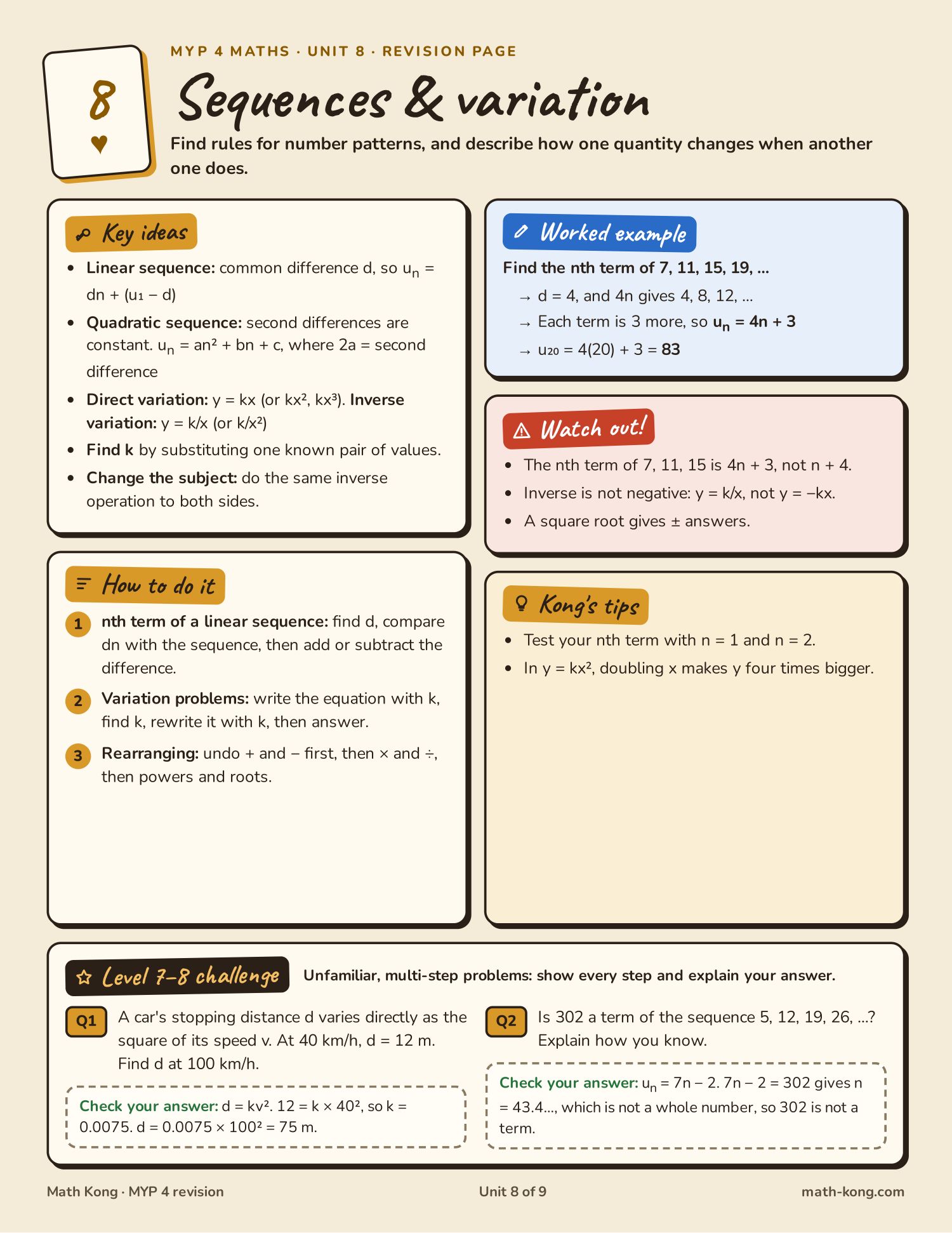
Read this revision page as text
Find rules for number patterns, and describe how one quantity changes when another one does.
Key ideas
- Linear sequence: common difference d, so uₙ = dn + (u₁ − d)
- Quadratic sequence: second differences are constant. uₙ = an² + bn + c, where 2a = second difference
- Direct variation: y = kx (or kx², kx³). Inverse variation: y = k/x (or k/x²)
- Find k by substituting one known pair of values.
- Change the subject: do the same inverse operation to both sides.
How to do it
- nth term of a linear sequence: find d, compare dn with the sequence, then add or subtract the difference.
- Variation problems: write the equation with k, find k, rewrite it with k, then answer.
- Rearranging: undo + and − first, then × and ÷, then powers and roots.
Worked example
- Find the nth term of 7, 11, 15, 19, …
- → d = 4, and 4n gives 4, 8, 12, …
- → Each term is 3 more, so uₙ = 4n + 3
- → u₂₀ = 4(20) + 3 = 83
Watch out!
- The nth term of 7, 11, 15 is 4n + 3, not n + 4.
- Inverse is not negative: y = k/x, not y = −kx.
- A square root gives ± answers.
Kong's tips
- Test your nth term with n = 1 and n = 2.
- In y = kx², doubling x makes y four times bigger.
Level 7–8 challenge
- Unfamiliar, multi-step problems: show every step and explain your answer.
- Q1 A car's stopping distance d varies directly as the square of its speed v. At 40 km/h, d = 12 m. Find d at 100 km/h.
- Check your answer: d = kv². 12 = k × 40², so k = 0.0075. d = 0.0075 × 100² = 75 m.
- Q2 Is 302 a term of the sequence 5, 12, 19, 26, …? Explain how you know.
- Check your answer: uₙ = 7n − 2. 7n − 2 = 302 gives n = 43.4…, which is not a whole number, so 302 is not a term.
Quick notes
kong's tipTest your nth term with n = 1 and n = 2 — if it gives the first two terms, you're golden. For variation: write it with k, find k, rewrite it, then answer.
Worked example
Find the nth term of 7, 11, 15, 19, …
- d = 4, and 4n gives 4, 8, 12, …
- Each term is 3 more, so uₙ = 4n + 3
- u₂₀ = 4(20) + 3 = 83
watch outThe nth term of 7, 11, 15 is 4n + 3, not n + 4. Inverse is not negative: y = k/x, not y = −kx. A square root gives ± answers.
How to do it
In y = kx², doubling x makes y four times bigger. In y = k/x, doubling x halves y.
Ready? Take the quiz below ↓
Five quick questions on this unit. No timer, no pressure — you can retry the whole set. Want it harder? Try the ⚡ challenge set after.