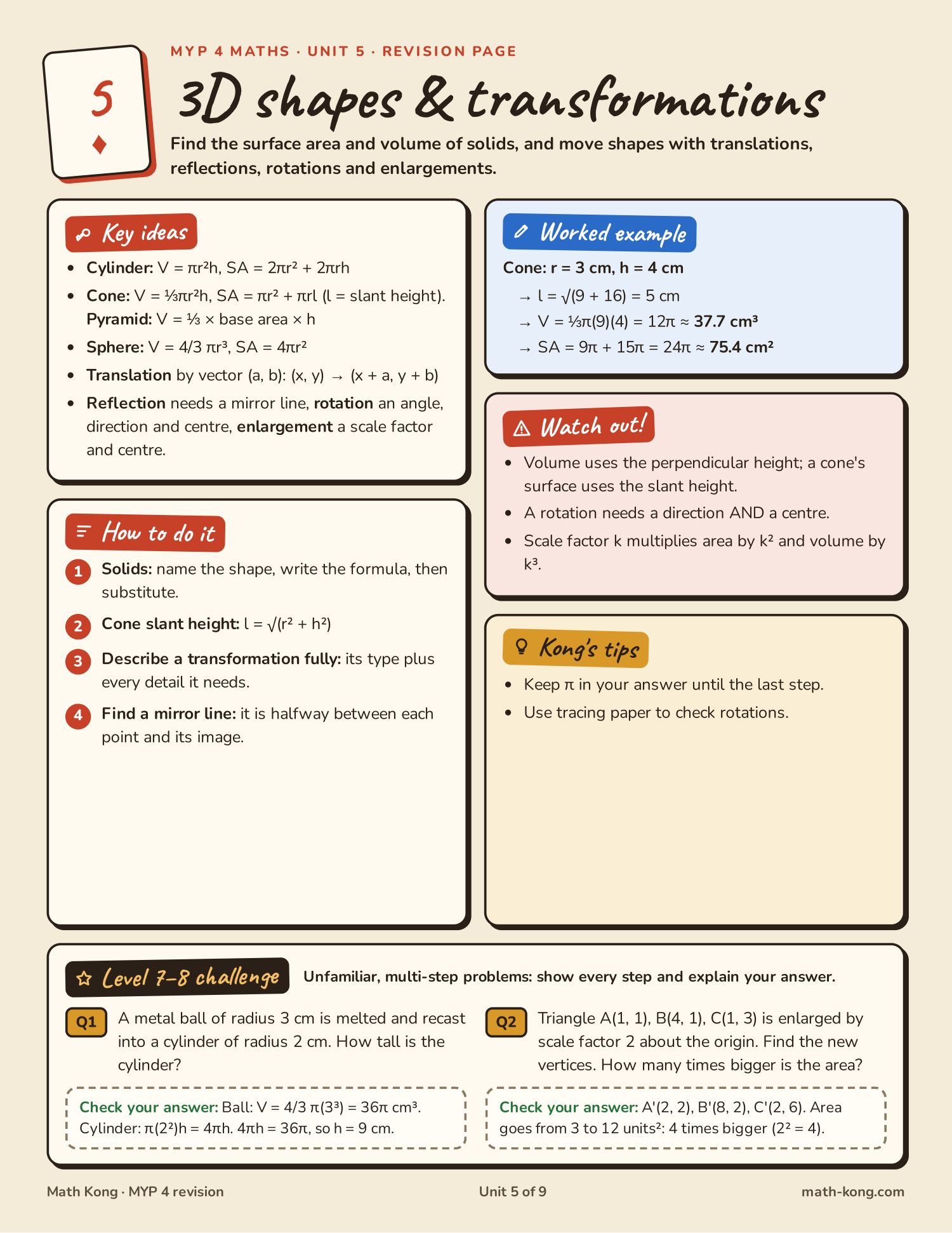
Read this revision page as text
Find the surface area and volume of solids, and move shapes with translations, reflections, rotations and enlargements.
Key ideas
- Cylinder: V = πr²h, SA = 2πr² + 2πrh
- Cone: V = ⅓πr²h, SA = πr² + πrl (l = slant height). Pyramid: V = ⅓ × base area × h
- Sphere: V = 4/3 πr³, SA = 4πr²
- Translation by vector (a, b): (x, y) → (x + a, y + b)
- Reflection needs a mirror line, rotation an angle, direction and centre, enlargement a scale factor and centre.
How to do it
- Solids: name the shape, write the formula, then substitute.
- Cone slant height: l = √(r² + h²)
- Describe a transformation fully: its type plus every detail it needs.
- Find a mirror line: it is halfway between each point and its image.
Worked example
- Cone: r = 3 cm, h = 4 cm
- → l = √(9 + 16) = 5 cm
- → V = ⅓π(9)(4) = 12π ≈ 37.7 cm³
- → SA = 9π + 15π = 24π ≈ 75.4 cm²
Watch out!
- Volume uses the perpendicular height; a cone's surface uses the slant height.
- A rotation needs a direction AND a centre.
- Scale factor k multiplies area by k² and volume by k³.
Kong's tips
- Keep π in your answer until the last step.
- Use tracing paper to check rotations.
Level 7–8 challenge
- Unfamiliar, multi-step problems: show every step and explain your answer.
- Q1 A metal ball of radius 3 cm is melted and recast into a cylinder of radius 2 cm. How tall is the cylinder?
- Check your answer: Ball: V = 4/3 π(3³) = 36π cm³. Cylinder: π(2²)h = 4πh. 4πh = 36π, so h = 9 cm.
- Q2 Triangle A(1, 1), B(4, 1), C(1, 3) is enlarged by scale factor 2 about the origin. Find the new vertices. How many times bigger is the area?
- Check your answer: A′(2, 2), B′(8, 2), C′(2, 6). Area goes from 3 to 12 units²: 4 times bigger (2² = 4).
Quick notes
kong's tipName the shape, write the formula, then substitute — and keep π in your answer until the very last step. Tracing paper is your best friend for checking rotations.
Worked example
Cone: r = 3 cm, h = 4 cm
- l = √(9 + 16) = 5 cm
- V = ⅓π(9)(4) = 12π ≈ 37.7 cm³
- SA = 9π + 15π = 24π ≈ 75.4 cm²
watch outVolume uses the perpendicular height; a cone's curved surface uses the slant height. A rotation needs a direction AND a centre. Scale factor k multiplies area by k² and volume by k³.
How to do it
Cone slant height: l = √(r² + h²). Then SA = πr² + πrl.
Ready? Take the quiz below ↓
Five quick questions on this unit. No timer, no pressure — you can retry the whole set. Want it harder? Try the ⚡ challenge set after.