Read this revision page as text
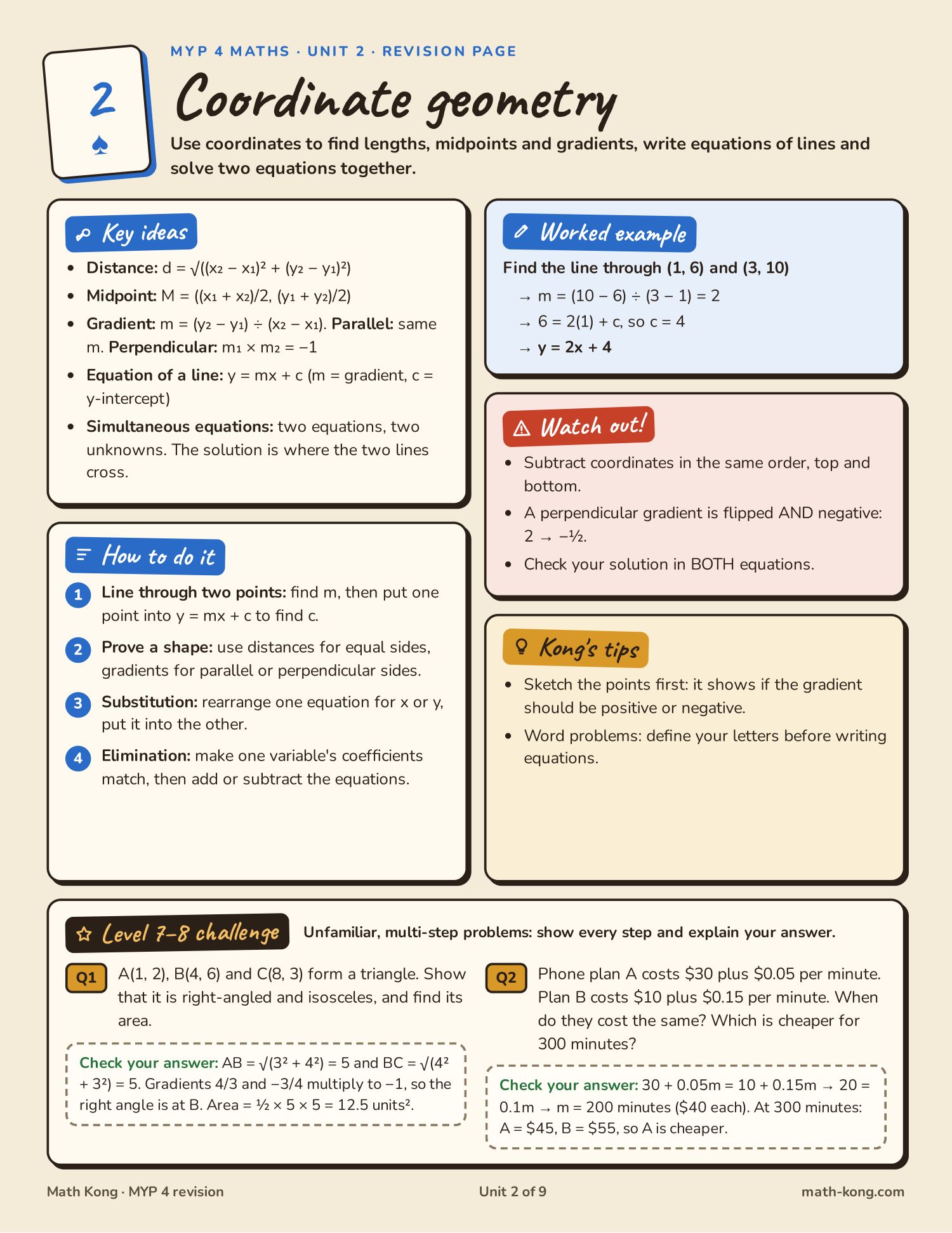
Use coordinates to find lengths, midpoints and gradients, write equations of lines and solve two equations together.
Key ideas
- Distance: d = √((x₂ − x₁)² + (y₂ − y₁)²)
- Midpoint: M = ((x₁ + x₂)/2, (y₁ + y₂)/2)
- Gradient: m = (y₂ − y₁) ÷ (x₂ − x₁). Parallel: same m. Perpendicular: m₁ × m₂ = −1
- Equation of a line: y = mx + c (m = gradient, c = y-intercept)
- Simultaneous equations: two equations, two unknowns. The solution is where the two lines cross.
How to do it
- Line through two points: find m, then put one point into y = mx + c to find c.
- Prove a shape: use distances for equal sides, gradients for parallel or perpendicular sides.
- Substitution: rearrange one equation for x or y, put it into the other.
- Elimination: make one variable's coefficients match, then add or subtract the equations.
Worked example
- Find the line through (1, 6) and (3, 10)
- → m = (10 − 6) ÷ (3 − 1) = 2
- → 6 = 2(1) + c, so c = 4
- → y = 2x + 4
Watch out!
- Subtract coordinates in the same order, top and bottom.
- A perpendicular gradient is flipped AND negative: 2 → −½.
- Check your solution in BOTH equations.
Kong's tips
- Sketch the points first: it shows if the gradient should be positive or negative.
- Word problems: define your letters before writing equations.
Level 7–8 challenge
- Unfamiliar, multi-step problems: show every step and explain your answer.
- Q1 A(1, 2), B(4, 6) and C(8, 3) form a triangle. Show that it is right-angled and isosceles, and find its area.
- Check your answer: AB = √(3² + 4²) = 5 and BC = √(4² + 3²) = 5. Gradients 4/3 and −3/4 multiply to −1, so the right angle is at B. Area = ½ × 5 × 5 = 12.5 units².
- Q2 Phone plan A costs $30 plus $0.05 per minute. Plan B costs $10 plus $0.15 per minute. When do they cost the same? Which is cheaper for 300 minutes?
- Check your answer: 30 + 0.05m = 10 + 0.15m → 20 = 0.1m → m = 200 minutes ($40 each). At 300 minutes: A = $45, B = $55, so A is cheaper.
Quick notes
kong's tipSketch the points first — it tells you straight away whether the gradient should be positive or negative. For word problems, define your letters before you write any equations.
Worked example
Find the line through (1, 6) and (3, 10)
- m = (10 − 6) ÷ (3 − 1) = 2
- 6 = 2(1) + c, so c = 4
- y = 2x + 4
watch outSubtract coordinates in the same order, top and bottom. A perpendicular gradient is flipped AND negative: 2 → −½. Check a simultaneous solution in BOTH equations.
How to do it
Line through two points: find m first, then put one point into y = mx + c to find c.
Ready? Take the quiz below ↓
Five quick questions on this unit. No timer, no pressure — you can retry the whole set. Want it harder? Try the ⚡ challenge set after.